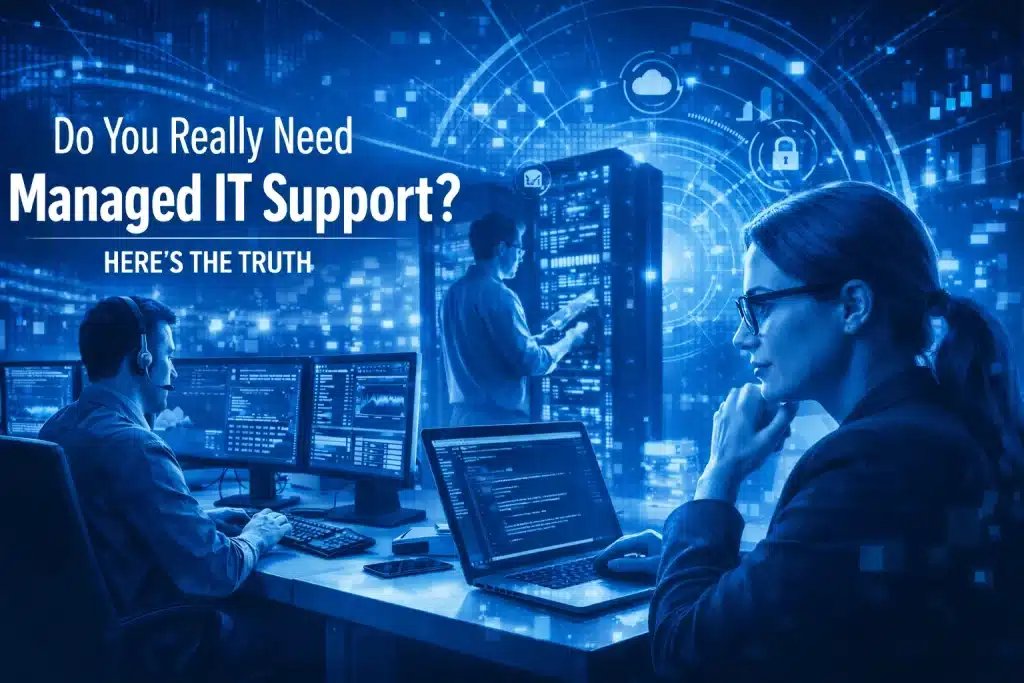
If you’re running a business, you’ve probably reached a point where you’ve asked yourself: “Do I actually need to pay someone to manage my IT, or can we just keep handling it ourselves?”
It’s a fair question. When things are running smoothly, IT support feels like an invisible expense. You see the invoice every month, but your printers are printing, your email is working, and nobody is complaining. It’s tempting to think you could save a few dollars by just calling someone when things break.
But here’s the truth: the “break-fix” model is a bit like only visiting the dentist when your teeth start falling out. By the time you notice a problem, the damage is already done, and the bill is going to be significantly higher than if you’d just gone in for regular checkups.
In this post, we’re going to pull back the curtain on managed IT support. We’ll look at the real costs, the hidden risks of going solo, and how to decide if your business actually needs professional help.
The Financial Reality: In-House vs. Managed IT
Let’s talk numbers first, because that’s usually where the decision starts. A lot of business owners assume that hiring an IT person or keeping it “in-house” is the cheaper route. However, the data tells a different story.
Research shows that organizations that move to managed IT services typically reduce their overall technology costs by 25% to 45%.
Why is that? Think about the cost of a single in-house IT specialist. Between salary, benefits, training, and office space, you’re looking at a significant investment. For a medium-sized firm with 40 employees, maintaining two in-house specialists could easily cost upwards of $195,000 a year. In contrast, switching to a managed service provider (MSP) could bring that cost down to around $60,000 annually while providing 24/7 coverage and a broader range of expertise.

When you hire an MSP, you aren’t just hiring one person; you’re hiring a team. You get access to security experts, cloud architects, and helpdesk specialists for a fraction of the cost of hiring those individuals separately.
The “Invisible” Costs of DIY IT
When you handle IT yourself: or delegate it to the “tech-savvy” person in the office who actually has another job: you aren’t saving as much as you think. There are hidden costs that don’t show up on a balance sheet until it’s too late.
1. The Cost of Downtime
How much does it cost your business if your systems go down for four hours? Calculate the hourly wages of every employee who can’t work, plus the lost revenue from customers who can’t reach you. Most small businesses spend $5,000 to $10,000 per user per year on internal IT management when you factor in these inefficiencies. Managed services have been shown to reduce downtime by up to 85% because they focus on prevention rather than just repair.
2. Recruitment and Training
IT is one of the fastest-moving industries in the world. If you have an internal staff member, you have to pay to keep them trained on the latest security threats and software updates. If they leave, you’re hit with recruitment costs that often equal 50-60% of their annual salary. With a managed partner, that burden is entirely off your shoulders.
3. Enterprise-Grade Tools
Managed IT providers invest in high-end monitoring and security tools that are often too expensive for a single small business to purchase on its own. When you partner with a provider, you get the benefit of these tools as part of your service fee.

Proactive vs. Reactive: The Great Shift
The biggest “truth” about managed IT support is that it changes the fundamental relationship between you and your technology.
In a traditional setup, your IT person’s goals are actually the opposite of yours. If they charge by the hour, they make more money when things are broken. There is no financial incentive for them to ensure your systems never fail.
Managed IT flips this. Because you pay a flat monthly fee, it is in the provider’s best interest to make sure your systems run perfectly. If you have a problem, it costs the provider time and resources. Therefore, they spend their energy on proactive maintenance:
- Automated patching and updates.
- 24/7 threat monitoring.
- Predictive hardware replacement (replacing a failing drive before it crashes).
- Strategic consultancy to ensure your tech supports your business goals.
Cybersecurity: The Non-Negotiable Factor
Ten years ago, a small business could get away with basic antivirus software and a firewall. Today, that’s like leaving your front door wide open with a sign saying “Valuables inside.”
Cyberattacks are no longer just a problem for big corporations. Small businesses are often preferred targets because they usually have weaker security. A managed IT partner provides a level of cybersecurity expertise that is almost impossible to maintain internally. They manage your Google Workspace security, monitor for suspicious login activity, and ensure your backups are actually working and isolated from the main network.
If you’re handling your own IT, do you know for a fact that your last backup was successful? Do you know if your team is using Multi-Factor Authentication (MFA) on every single account? If the answer is “I think so,” you probably need managed support.

Do You Actually Need It?
Let’s be honest: not every single business needs a full managed service contract. If you are a solo consultant with one laptop and a Gmail account, you’re probably fine.
However, you should seriously consider managed IT support if:
- You have 5 or more employees: The complexity of managing permissions, devices, and security scales quickly.
- You handle sensitive data: If you store customer credit card info, medical records, or legal documents, the risk of a breach is too high to manage alone.
- You are growing: If you plan to add staff in the next 12 months, you need a scalable deployment strategy.
- Downtime is a dealbreaker: If your business stops when the internet or your software stops, you need proactive monitoring.
Making the Move
Transitioning to managed IT isn’t about giving up control; it’s about gaining freedom. It allows you to stop worrying about server updates and start focusing on your customers.
At Cloud Computer Company, we see ourselves as a partner in your growth. We don’t just fix things; we help you use cloud services and modern communications to work smarter.
If you’re tired of the “break-fix” cycle and want to know exactly what your IT costs will be every month, it might be time to have a conversation. You can check out our support services here or reach out to us directly for a chat.
The truth is, your IT should be like the electricity in your office: it should just work, without you having to think about how the wiring is done.

About Mathew

Mathew Hoffman is the Owner of Cloud Computer Company. He began his career in the IT industry back in 1981, eventually moving into senior roles at the State Bank of NSW, Minet Australia, Wilhelmsen Lines, and Rothmans of Pall Mall. One of the highlights of his career was working on the technology team for the Sydney 2000 Olympics.
Since 2001, Mathew has focused on providing expert IT consultancy to small and medium businesses. He was an original Google Partner in 2008 and re-branded the business to Cloud Computer Company in 2017 to reflect the shift toward modern cloud solutions. Now based in Noosa, Mathew is an avid cricket fan who has played and coached in both Sydney and the Sunshine Coast. When he’s not helping businesses streamline their tech, you’ll find him spending time with his family, enjoying the beach, or hitting the golf course.