
If you’ve opened a web browser over the last twenty-five years, your digital muscle memory is pretty much identical to mine. You type a few fragmented keywords into a blank white box, hit enter, and scan a list of “ten blue links.” You click a site, maybe realise it’s not what you wanted, hit back, and try another. It’s a rhythmic, mechanical process that has defined the information age.
Well, I hope you enjoyed that era, because according to the tech world, it’s officially history.
At the latest Google I/O conference, Google announced what it’s calling the single biggest change to Search since the search box first appeared. TechCrunch summarised the paradigm shift bluntly: “Google Search as you know it is over.”
The iconic “ten blue links” model isn’t just taking a backseat, it is actively being written out of the script. Here is what is actually changing, what it means for how your business uses the internet, and why it’s triggering a massive existential crisis for the open web.
Meet the “Intelligent Search Box”
The core change starts with the entry point we use every single day. The search box has been completely rebuilt from the ground up.
Historically, Google required us to speak its language. We had to translate our organic thoughts into rigid, mechanical keyword phrases that we thought the algorithm could rank. We became experts at “Google-fu,” learning exactly which terms would trigger the right results. Under the new overhaul, Google wants to meet you where the question actually lives in your head.
Powered by Gemini 3.5 Flash, the new search box expands dynamically. You are no longer restricted to a single line of text. You can feed it long, rambling, conversational queries. Even wilder, you can feed it mixed inputs simultaneously, dropping in text, images, files, videos, or even active Chrome tabs all at once.
Imagine you are trying to troubleshoot a piece of equipment in your office. Instead of typing “blinking red light on printer model X,” you can now take a video of the printer, drop it into the search box, and ask, “Why is it doing this, and can you find me the manual for the specific part shown at 0:05?” The search engine reasons across all these inputs to provide a comprehensive, direct answer.

Generative UI: A Search Engine That Assembles on the Fly
The most disorienting shift isn’t how you ask questions; it’s how Google answers them. Search results are no longer static templates pulled from a pre-determined index. Instead, Google is using agentic coding built on its “Antigravity” platform to generate custom interfaces on the fly.
If you ask a complex question, Search will dynamically assemble interactive visualisations, custom tables, simulations, and tailored layouts built uniquely around your specific question. As Google’s VP of Search, Liz Reid, framed it, Search is morphing from a place where you go to find answers into a “persistent and stateful project space.”
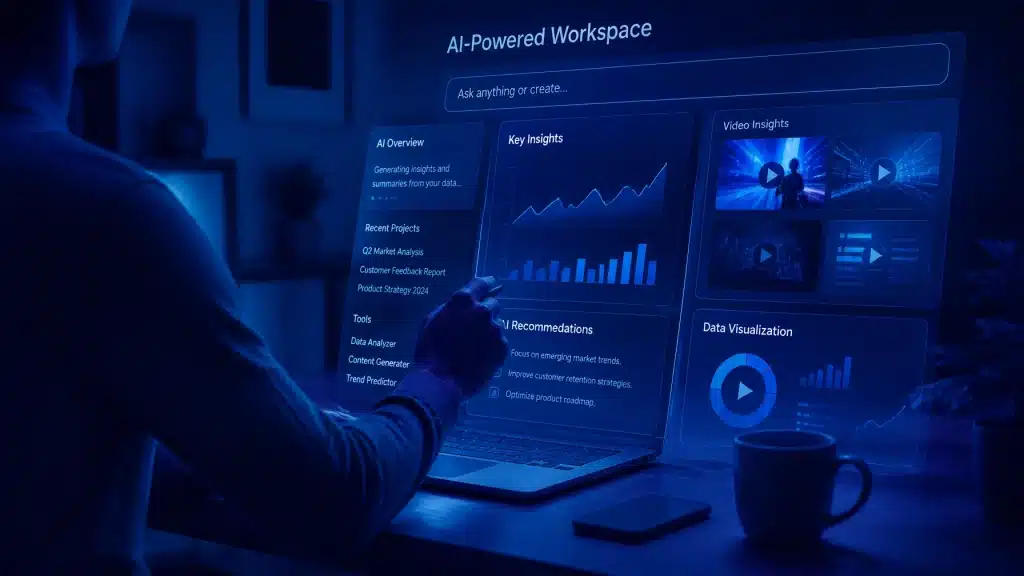
This is a fundamental shift for businesses. Instead of finding a blog post that describes a solution, the search engine might generate a custom calculator or a mini-app that solves the problem right there in the browser. It’s becoming less of a digital card catalogue and more of an AI-powered workspace. For teams already using Google Workspace, this integration is set to become even tighter, blurring the lines between searching for info and acting on it.
Moving from Finding to Doing: The Rise of Search Agents
For simple, low-stakes questions (“What year did the Sydney Olympics start?” or “What is the current exchange rate?”), you won’t notice a massive difference. Google’s AI Overviews have been intercepting those queries for a couple of years now anyway.
But for the “messy” questions, the ones that normally require opening five different tabs, spending an hour comparing options, sketching out a plan, or interpreting complex data, Google’s new “Search Agents” are taking over.
Information Agents
These agents work in the background, 24/7. You can task an agent within Search to monitor a specific topic, say, changes in cybersecurity regulations for small businesses, and it will continuously reason across new information sources, surfacing what you need exactly when it becomes relevant.
Agentic Booking
The AI will do the heavy lifting, aggregate the data, track moving topics, and present the finished product to you without you ever needing to click through to an external website. Google even demonstrated Search handling complex booking tasks, such as finding a private venue with specific catering requirements and presenting the final availability and pricing in one go.

The Elephant in the Room: Is This the Death of the Open Web?
While tech optimists are marvelling at the sheer convenience of a workspace-driven search engine, web publishers, creators, and business owners are feeling a distinct chill.
Think about the economic lifecycle of the internet. Independent guides, news outlets, blogs, and niche creators publish high-quality content. Google indexes it. Users click the links, the creators get traffic, they generate ad revenue or subscriptions, and that money funds them to create more content.
If Google acts as an all-knowing layer that scrapes that content, synthesises it, and keeps users locked inside its own “walled garden,” that referral traffic evaporates. Without traffic, websites lose revenue. Without revenue, they shut down. This is why many experts are concerned about the “cannibalisation” of the web, if the creators disappear, what data will future AI models even train on?
Google has stepped in to clarify that “AI Mode” is a feature users navigate to and that traditional blue links aren’t being erased entirely. But let’s be real: convenience is a massive trap. If an AI hands us a “good enough” summary right at the top of the fold, the vast majority of users aren’t going to scroll down to click an external link. For businesses relying on organic search traffic, the strategy must shift from “being found” to “being the source of truth” that AI agents rely on.
Navigating the Shift with Cloud Computer Company
At Cloud Computer Company, we’ve seen many “deaths” of technology over the decades. We’ve seen the transition from local servers to the cloud, and from desktop-bound offices to remote-first workforces. Each shift brings a period of uncertainty, but also immense opportunity.
The death of traditional search doesn’t mean the death of information; it means the birth of a new way to work. Businesses that thrive in this new era will be those that:
- Modernise their Infrastructure: Ensuring your team is proficient with tools like Gemini and Google Workspace is no longer optional. Our user training programs are designed to bridge this gap.
- Focus on Data Security: As search engines become more “stateful” and “agentic,” they handle more of your business data. Our Google Workspace Health and Security Checkups are critical for ensuring your “walled garden” remains secure.
- Embrace Managed Support: Navigating the technical complexities of the Antigravity platform and AI integration requires expert guidance. Our managed IT support ensures your business isn’t left behind by the rapid pace of Google’s updates.

My Take
We are watching a massive pivot from an open internet to a corporate-curated ecosystem. On one hand, having an AI agent efficiently map out complex projects, build custom interfaces, and save me hours of research sounds incredibly empowering. It allows small business owners to punch well above their weight.
On the other hand, I can’t help but worry about what we lose when we stop visiting the actual homes of the people who create the knowledge we rely on. When the internet stops being built for humans to browse and starts being optimised strictly for AI bots to ingest, the soul of the web shifts.
Google Search is no longer an engine that points you toward the map of human knowledge, it wants to be the knowledge. Whether that makes our lives easier or flattens the internet into an AI-generated monoculture remains to be seen. One thing is certain: the era of “ten blue links” was just the beginning.
About Mathew Hoffman
Mathew Hoffman is the owner of Cloud Computer Company. He started his career in IT back in 1981, holding senior roles at institutions such as the State Bank of NSW, Minet Australia, Wilhelmsen Lines, and Rothmans of Pall Mall. A career highlight was his involvement in the IT infrastructure for the Sydney 2000 Olympics. Since 2001, Mathew has focused on providing expert IT consultancy to small and medium businesses. He was an original Google Partner in 2008 and re-branded his firm to Cloud Computer Company in 2017 to better reflect the modern digital landscape.
Based in beautiful Noosa, Mathew is a dedicated family man who enjoys the beach and a round of golf. He has a lifelong passion for cricket, having both played and coached the sport in Sydney and on the Sunshine Coast.