We’ve all been there. You’re in the middle of a big project, the deadline is breathing down your neck, and you need that one specific PDF. You check your email. Not there. You check the shared drive. It’s a mess of folders named “New Folder (2)” and “Old Stuff.” You ask a colleague, and they say they sent it via Slack three days ago.
By the time you actually find the document, you’ve lost twenty minutes of productivity and gained a headache.
Document sharing should be the easiest part of your day, but for many businesses, it’s a source of constant friction. If your team is struggling to collaborate, it’s usually not because they aren’t trying; it’s because the system they’re using is broken.
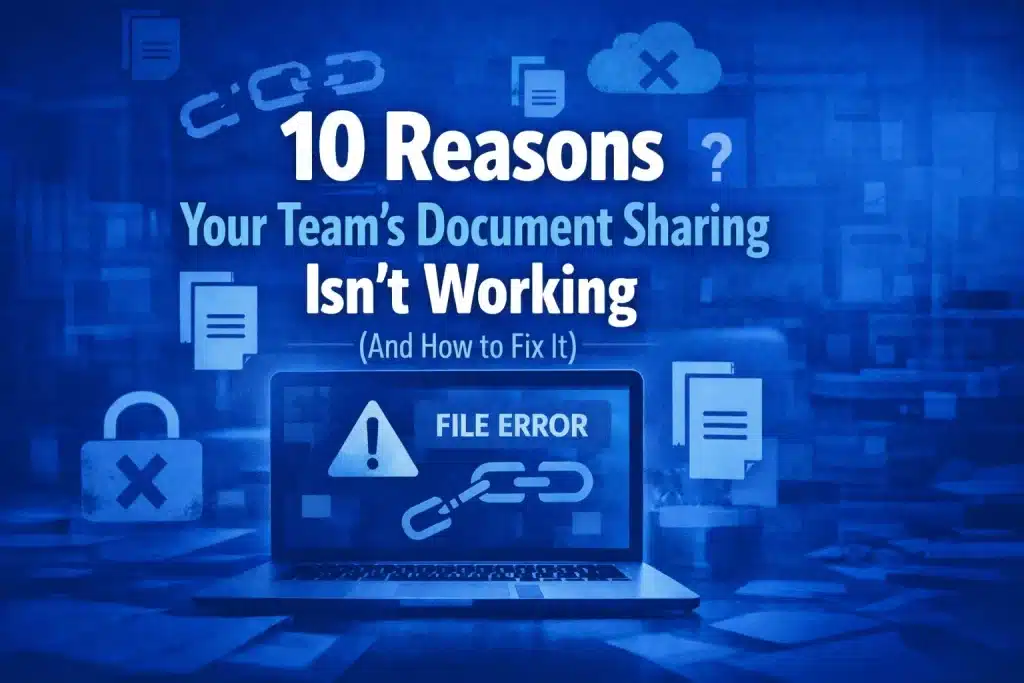
Here are 10 reasons why your team’s document sharing isn’t working: and more importantly, how you can fix it.
1. The Great Digital Scavenger Hunt
The biggest killer of productivity is a lack of centralized storage. When some files live on a local server, others are in personal Dropbox accounts, and the rest are floating around as email attachments, your team spends more time searching than working.
The Fix: You need a single source of truth. Move your operations to a unified cloud collaboration platform like Google Workspace or Microsoft 365. When everyone knows exactly where the “Final Reports” folder is, the scavenger hunt ends.
2. “Final_v2_REAL_final_v3.docx”
We’ve all seen this nightmare. Version control chaos happens when people download a file, edit it locally, and then re-upload it with a slightly different name. Before you know it, there are five versions of the same document, and nobody knows which one is actually the current one.
The Fix: Stop downloading files. Use platforms that support real-time co-authoring. When everyone edits the same live link, there is only ever one version of the document. Most modern cloud systems even have a built-in version history so you can see who changed what and revert back if someone accidentally deletes a paragraph.

3. The Email Black Hole
Email was never meant to be a file storage system. Sending attachments back and forth creates duplicate files, clogs up inboxes, and makes it nearly impossible to track revisions. Plus, if a staff member leaves and their inbox is deactivated, those documents might be gone forever.
The Fix: Ban internal attachments. Instead of attaching a file, send a link to the document stored in your shared cloud drive. This keeps your inbox light and ensures everyone is always looking at the most up-to-date information.
4. “File Too Large to Send”
It’s 4:55 PM, and you’re trying to send a high-res presentation to a client. Then it happens: the dreaded bounce-back email because the file is over 25MB. Some teams try to solve this by using random third-party transfer sites, which creates a huge security risk.
The Fix: Use cloud-based sharing links. Instead of sending the actual bytes through the email server, you’re just sending a key. This allows you to “send” files that are gigabytes in size without ever hitting a limit.
5. The “Wild West” of Folder Structures
Even if you have a shared drive, it’s useless if the organization is non-existent. If every employee has their own unique way of naming files (e.g., “Invoice1” vs. “2024-05-INV-Smith”), the system will eventually collapse under its own weight.
The Fix: Implement a standard naming convention and folder hierarchy. A simple rule like [Date] – [Project Name] – [Document Type] can save hours of confusion. If you need help setting up a logical structure, our consultancy services can help design a workflow that actually makes sense for your business.

6. Accidental Deletion Panic
In a shared environment, it only takes one accidental “Drag and Drop” or a stray click of the “Delete” key to send a critical folder into the void. If you don’t have a clear recovery path, that data could be lost.
The Fix: Ensure your team is using a system with a robust “Trash” or “Recycle Bin” and version history. More importantly, make sure you have a managed backup solution in place. At Cloud Computer Company, we often recommend a Google Workspace Health and Security Checkup to ensure your data recovery settings are properly configured.
7. Clutter and Duplicate Chaos
When files are easy to copy, they get copied… a lot. You end up with the same “Employee Handbook” in four different folders. This doesn’t just eat up storage space; it creates a risk that someone will read an outdated version of a policy.
The Fix: Use “Shortcuts” or “Aliases.” Instead of copying a file into a second folder, create a shortcut to the original. This way, you only have one file to update, but it’s accessible from multiple locations.
8. The “Wait for it” Bottleneck
Workflow bottlenecks happen when a team member can’t start their task until someone else emails them a file. If that person is in a meeting or out for the day, the whole project grinds to a halt.
The Fix: On-demand access. Set up project-based shared drives where everyone involved has access from day one. When the work is always available to the people who need it, you remove the “gatekeeper” and speed up your entire business process.

9. Permission Denied (Or Way Too Open)
Getting permissions right is a balancing act. If they’re too strict, people can’t do their jobs. If they’re too loose, everyone has access to the payroll spreadsheet. Often, teams get frustrated and just share everything with “Anyone with the link,” which is a massive security hole.
The Fix: Use group-based permissions. Rather than managing access person-by-person, create groups (like “Marketing” or “Finance”). When a new person joins the team, you just add them to the group, and they instantly have the right level of access to the right folders.
10. Ghost Access and Security Leaks
What happens to your documents when an employee or a contractor leaves the business? If they were using personal accounts or if permissions weren’t revoked, they might still have access to your sensitive intellectual property months or years later.
The Fix: Centralized management is a must. With managed IT support, you have a formal offboarding process that revokes all access the moment someone leaves. This keeps your data inside the business where it belongs.

Getting Your Team Back on Track
Fixing document sharing isn’t just about picking the right software; it’s about changing the way your team thinks about data. It’s about moving away from “my files” and moving toward “our information.”
When you get this right, the frustration disappears. Projects move faster, communication is clearer, and you don’t have to spend your Friday afternoon hunting for a missing spreadsheet.
If your current setup feels like more of a hurdle than a help, let’s chat. We specialize in helping businesses streamline their cloud collaboration and secure their digital workspace. You can reach out to us here to get started.
About Mathew

Mathew Hoffman is the Owner of Cloud Computer Company. He started his career in the IT industry back in 1981, eventually moving into senior roles at the State Bank of NSW, Minet Australia, Wilhelmsen Lines, and Rothmans of Pall Mall. One of the highlights of his career was working on the IT infrastructure for the Sydney 2000 Olympics.
Since 2001, Mathew has focused on providing expert IT consultancy to small and medium businesses. He was one of the original Google Partners in 2008 and re-branded the business to Cloud Computer Company in 2017 to reflect his focus on modern cloud solutions. Now based in Noosa, Mathew is a big fan of cricket: having played and coached in both Sydney and the Sunshine Coast. When he’s not helping businesses solve their tech puzzles, you’ll find him spending time with his family, hitting the beach, or enjoying a round of golf.