Managing a team used to be simple. You could look across the office, see who was on a call, who was deep in focus, and who was grabbing a coffee. But the world has changed. By 2026, the “office” is anywhere with a decent Wi-Fi signal. While this flexibility is great for lifestyle and talent acquisition, it’s created a massive headache for business owners trying to keep their communications professional and their teams connected.
If you’re still relying on traditional desk phones or, heaven forbid, asking your staff to use their personal mobile numbers to call clients, you’re making life much harder than it needs to be. Cloud-based phone systems (often called VoIP) aren’t just a “nice-to-have” upgrade anymore; they are the backbone of modern remote team management.
Let’s dive into why moving your communications to the cloud will fundamentally change the way you run your business.
The Death of the “Desk” Phone
The biggest shift is psychological. In the old days, your phone number lived in a wire that came out of a wall. If you weren’t standing next to that wire, you didn’t exist to your customers.
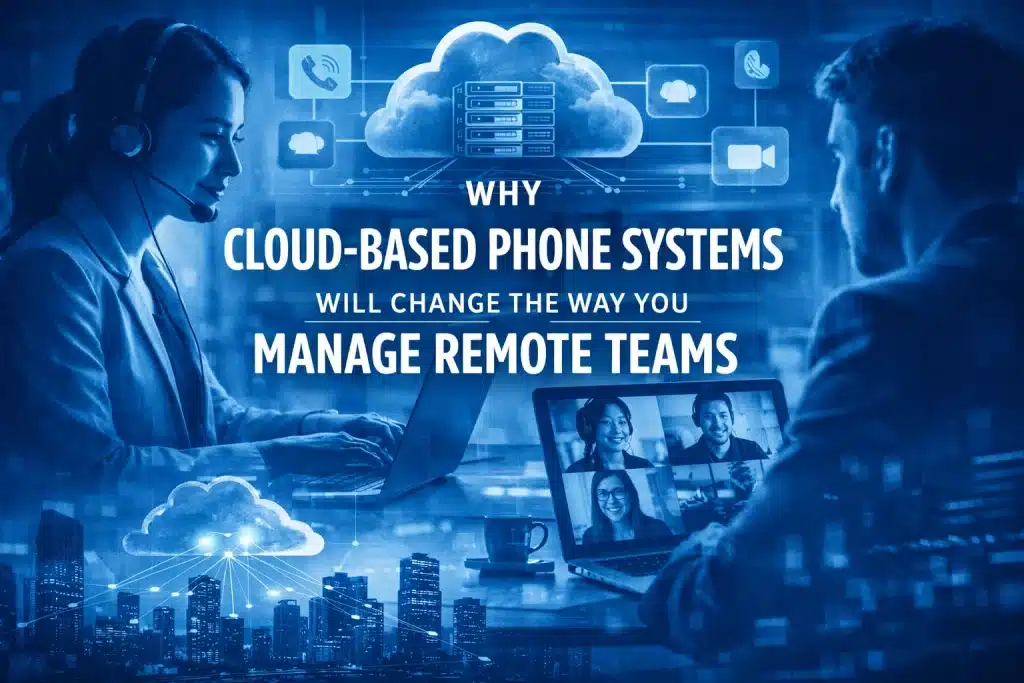
Cloud-based systems change that. Your phone system is now a piece of software. It lives on your laptop, your tablet, and an app on your smartphone. For a manager, this means your team is reachable no matter where they are. Whether they are working from a home office in Noosa or a co-working space in the city, they have the exact same tools as if they were sitting right next to you.

1. Professionalism Without the Personal Intrusion
One of the biggest risks with remote teams is “number sprawl.” When staff work from home without a cloud system, they often start giving out their personal mobile numbers to clients.
This is a recipe for disaster. First, it’s a privacy nightmare for your staff. They can’t “switch off” because clients have their personal number. Second, if that staff member leaves your business, they take those client relationships (and the contact history) with them.
With a cloud system, your team makes and receives calls via an app, but the client sees your professional business number. It keeps the boundaries clear and ensures that your business identity remains consistent, regardless of which couch your employee is sitting on. You can check out more about how this fits into your broader strategy at our cloud-business section.
2. Unified Communications: One Tool to Rule Them All
Managing a remote team often feels like juggling five different balls at once. You have one app for chat, another for video calls, a separate system for phone calls, and maybe another for file sharing.
The beauty of modern cloud-based communications is that they bring all of this into one place. When your phone system is in the cloud, it usually integrates directly with your messaging and video conferencing.
Imagine a scenario where a staff member is on a call with a client. They realize they need a technical expert to weigh in. In a cloud system, they can see at a glance if the expert is “available” on chat, send them a quick message, and then click one button to turn that voice call into a three-way video conference. No hanging up, no “I’ll call you back,” and no friction.
3. Real-Time Management and Analytics
How do you know if your remote sales team is actually making calls? How do you know if your support desk is overwhelmed?
With a traditional system, you’d have to wait for the monthly bill or just “trust your gut.” In the cloud, you have a live dashboard. You can see call volumes, wait times, and call durations in real-time.
This isn’t about being “Big Brother.” It’s about having the data to support your team. If you see that call wait times are spiking on a Tuesday morning, you can jump in and assign more people to the queue. If you see a staff member is spending twice as long on calls as everyone else, it might be a sign they need more training or support. This level of it-support for your own management style is invaluable.

4. Scalability That Moves at Your Speed
If you’ve ever had to wait three weeks for a technician to come out and install a new phone line because you hired a new person, you know how frustrating traditional systems are.
With a cloud-based system, adding a new user takes about 30 seconds. You log into a portal, create an extension, and send an invite link to your new hire. They download the app, and they’re part of the team.
This is particularly huge for businesses with seasonal fluctuations. If you need to scale up your support team for a busy month, you can add lines instantly and then remove them just as easily when things quiet down. You only pay for what you use, which is a core part of the 7 advantages of cloud computing in business.
5. Integrating with the Tools You Already Use
Most businesses today are living in Google Workspace or a similar ecosystem. A cloud-based phone system shouldn’t live in a silo; it should talk to your other tools.
When a client calls, a good cloud system can “pop up” their details from your CRM or Google Contacts before you even pick up the phone. It can automatically log the call record, attach a recording of the conversation to the client’s file, and even transcribe the voicemail into an email.
This removes the manual data entry that remote workers often “forget” to do, ensuring your records are always accurate. It’s a major part of why we focus so heavily on Google Workspace integrations.

6. Disaster Recovery and Reliability
What happens if the power goes out at your main office? With a traditional system, your phones go dead.
With a cloud system, your business keeps running. Because the “brains” of the system are in a secure data center, the system doesn’t care if your office has power. Calls can be automatically routed to mobile apps or redirected to another location. Your customers will never even know there was a problem.
In the world of security and business continuity, this peace of mind is worth its weight in gold.
Making the Switch
The transition to a cloud-based phone system is usually much easier than people expect. You don’t need to replace all your hardware (though you can get fancy new desk phones if you want them), and you can almost always keep your existing phone numbers.
It’s about moving away from the limitations of hardware and embracing the flexibility of software. When your communication tools are as mobile as your workforce, managing a remote team stops being a struggle and starts being a competitive advantage.
If you’re ready to stop worrying about phone lines and start focusing on growth, it might be time to look into a VoIP solution that actually fits the way we work in 2026.

About Mathew Hoffman

Mathew Hoffman is the founder of Cloud Computer Company. He’s been working in IT since 1981, including senior roles at the State Bank of NSW, Minet Australia, Wilhelmsen Lines, and Rothmans of Pall Mall, plus involvement in IT operations for the Sydney 2000 Olympics.
Since 2001, Mathew has focused on practical IT consultancy for small and medium businesses. He became an original Google Partner in 2008 and re-branded to Cloud Computer Company in 2017 to reflect a cloud-first approach.
Now based in Noosa, Mathew’s a keen cricket fan (having played and coached in Sydney and on the Sunshine Coast). When he’s not helping businesses get more out of the cloud, he’s usually spending time with family, enjoying the beach, or getting in a round of golf.