It’s 2026, and the “office” looks a lot different than it did a few years ago. Maybe your team is scattered across the coast, working from home, or hitting the local cafe. But while the scenery has changed, one thing hasn’t: the hackers are still trying to get in. In fact, with AI-powered phishing and more sophisticated ransomware, they’re working harder than ever.
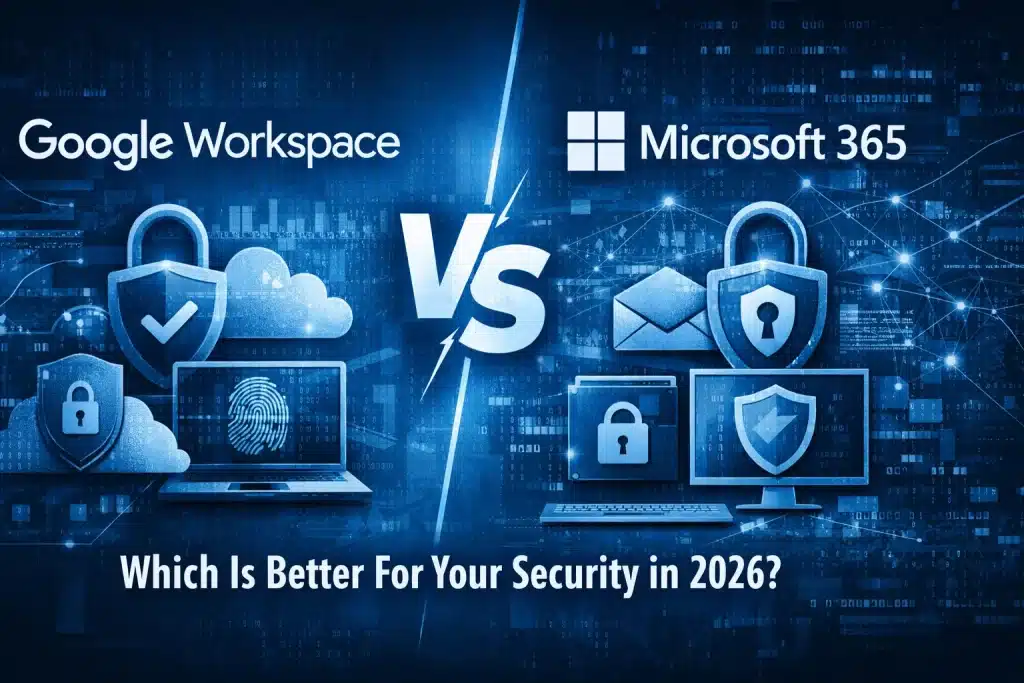
If you’re running a business today, you’re likely standing at a crossroads, looking at the two big titans of productivity: Google Workspace and Microsoft 365. Both claim to be the safest place for your data, but they go about security in very different ways.
So, which one should you trust with your business in 2026? Let’s break it down in plain English.
The Philosophical Divide: Browser-First vs. Hybrid
Before we look at the buttons and settings, we have to look at the “bones” of these platforms.
Google Workspace: The Cloud-Native Minimalist
Google Workspace was born in the cloud. It doesn’t really care if you’re using a Mac, a PC, or a tablet. Everything happens inside the browser. In 2026, this “browser-first” approach is Google’s secret weapon.
Why? Because when you work entirely in a browser, you significantly reduce what IT nerds call the “attack surface.” There are no local applications to patch, no outdated .exe files sitting on your hard drive waiting to be exploited, and no local “Save As” habits that lead to sensitive data living on a stolen laptop. It’s a “Zero Trust” model by default.
Microsoft 365: The Hybrid Powerhouse
Microsoft 365 grew up in the world of desktop software (think Word 95!). While their cloud features are incredible, most businesses still use the desktop versions of Outlook, Excel, and PowerPoint.
This hybrid approach: part cloud, part local software: gives you immense power, but it also creates more “doors” for hackers to knock on. You have to worry about securing the cloud and securing the physical computer it’s installed on.

AI-Driven Threat Detection: Who’s Smarter?
By 2026, manual security checks are a thing of the past. It’s all about AI.
Google uses its massive global network to spot threats before they even reach your inbox. Because Google handles a huge chunk of the world’s email traffic, their AI has seen every trick in the book. Google Workspace currently blocks over 99.9% of spam, phishing, and malware. In 2026, their “Vertex AI” integration means the system isn’t just looking for bad links; it’s looking for “intent.” It can tell if an email from your “CEO” feels a little bit “off” based on writing patterns and metadata.
Microsoft isn’t slouching, either. Microsoft Sentinel and Defender for Office 365 are world-class. They offer incredibly deep behavioral analysis. However, for a small to medium business, Microsoft’s security can sometimes feel like trying to fly a 747 when you just wanted to drive a Tesla. It’s powerful, but it requires a lot of “knob-turning” to get it right.
Complexity is the Enemy of Security
This is where the two platforms really drift apart for business owners.
At Cloud Computer Company, we often see that the biggest security risk isn’t a hacker: it’s a human error. A settings box left unchecked, a password not reset, or a file shared with the “public” by accident.
Google’s Simplicity
Google’s admin panel is built for humans, not just PhDs in Cybersecurity. Setting up 2-Factor Authentication (2FA) or checking who has access to a folder is straightforward. For an SMB, this simplicity is a security feature in itself. If it’s easy to manage, it actually gets managed.
If you’re worried your current setup isn’t quite right, we actually offer a Google Workspace Health and Security Checkup to make sure your “walls” are as high as they should be.
Microsoft’s Depth
Microsoft 365 offers tools like Entra ID (formerly Azure AD) and Purview. These are amazing if you have a full-time IT department of ten people. You can set 100 different conditions for how a user logs in. But for a smaller team, this complexity often leads to “security fatigue” or, worse, misconfigurations that leave a back door wide open.

Why We Are a Google Cloud Partner
You might have guessed by now that we’re big fans of the Google approach. Since 2008, we’ve seen how cloud collaboration transforms businesses.
As a Google Cloud Partner, we’ve helped countless teams move away from the “update and patch” cycle of traditional software. When you choose Google Workspace, you’re choosing a platform that was built for the way we work in 2026: fast, mobile, and secure by design.
Whether you need managed IT support or a full deployment plan, we focus on making sure your tech stays out of your way so you can actually do your job.
The Verdict for 2026
Choose Microsoft 365 if: You are in a highly regulated industry (like high-level finance or government) that requires very specific, granular compliance certifications (like FedRAMP High) and you have the budget for an IT team to manage the complexity.
Choose Google Workspace if: You want a “security first” culture that is easy for your employees to use and easy for you to manage. If you want the peace of mind that comes with a browser-based, AI-protected environment that just works, Google is the winner for 2026.

Still Unsure? Let’s Chat.
Security isn’t one-size-fits-all. What works for a solo consultant won’t work for a firm with 50 staff. If you’re trying to decide which platform will keep your business safe, or if you’re worried your current setup is a bit of a “leaky bucket,” get in touch with us at our contact page.
We’ve been doing this since before “the cloud” was even a buzzword, and we’d love to help you get your tech sorted.
Cheers,
Mathew Hoffman
Owner, Cloud Computer Company
About Mathew Hoffman

Mathew started his journey in the IT world back in 1981. Over the decades, he’s held senior roles at the State Bank of NSW, Minet Australia, Wilhelmsen Lines, and Rothmans of Pall Mall. One of his career highlights was working on the ground during the Sydney 2000 Olympics: a true masterclass in high-stakes tech.
Since 2001, Mathew has focused on providing top-tier IT consultancy to small and medium businesses. He was one of the original Google Partners back in 2008 and rebranded to Cloud Computer Company in 2017 to better reflect the modern tech landscape. Now based in Noosa, when he’s not securing networks, you’ll find him involved in cricket (having played and coached in both Sydney and the Sunshine Coast), spending time with his family at the beach, or working on his golf game.