If you had told me in 1981: when I first started my career in IT: that one day I’d be sitting in Noosa, managing entire business infrastructures through a web browser while an AI named Gemini helped me draft reports, I probably would have asked what planet you were from.
In 1981, “The Cloud” was something that ruined a weekend of cricket, not a place where you stored your company’s entire intellectual property.
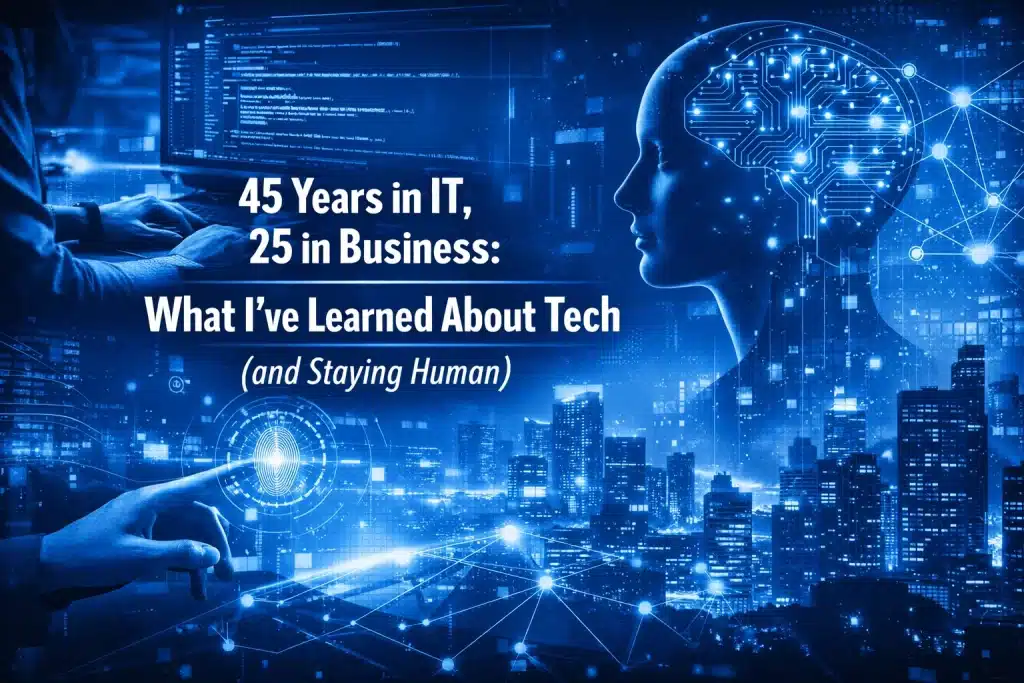
This year marks two massive milestones for me: 45 years in the IT industry and 25 years since I took the leap to start my own business. I’ve seen the world move from massive, climate-controlled rooms filled with humming mainframes to the sleek, serverless efficiency of Google Workspace.
Looking back, it hasn’t just been about learning new software or upgrading hardware. It’s been about learning how to stay human in a world that’s increasingly digital. Here’s a bit of a retrospective on where we’ve been, where we are, and what it takes to survive 45 years in the fastest-moving industry on Earth.
The Early Days: When Hardware was King
When I started out, IT was a heavy-lifting game. I spent the early part of my career working in senior roles for big names like the State Bank of NSW, Minet, Wilhelmsen Lines, and Rothmans of Pall Mall. Back then, if you wanted to change how a business operated, you didn’t just click a button; you ordered a piece of hardware the size of a refrigerator and waited weeks for it to arrive.
IT departments were often tucked away in basements. We were the “gatekeepers” of the data. Everything was local, everything was physical, and if a drive failed, you were in for a very long night.

One of the most intense and rewarding highlights of that era was working on the Sydney 2000 Olympics. It was a masterclass in scale, pressure, and the absolute necessity of reliable systems. When the eyes of the entire world are on you, “technical difficulties” aren’t an option. That experience solidified my belief that while tech is great, the strategy and the people behind it are what actually make things work.
2001: Trading the Corporate Ladder for My Name On The Door
After two decades in the corporate world, I decided it was time to do things differently. In 2001, I launched my own IT consultancy. The goal was simple: take that high-level corporate expertise and bring it to small and medium-sized businesses (SMBs) that were being underserved by the “big guys.”
For the first few years, I was doing what most IT guys did: fixing servers, running cables, and troubleshooting desktop blue screens. But I could feel the wind changing. The traditional model of buying expensive servers every five years was starting to feel outdated. It was expensive, it was a single point of failure, and it kept business owners tethered to their desks.
2008: The Year the “Cloud” Became Real
The real “lightbulb moment” happened in 2008. I became an original Google Partner, back when Google Workspace was still called “Google Apps for Your Domain.”
At the time, people thought I was crazy. “You want me to put my email in a web browser? What about my server?”
But I saw the potential immediately. It wasn’t just about email; it was about collaboration. It was about the freedom to work from anywhere. It was about security that an SMB could never afford on their own. I began moving my clients away from the “break-fix” hardware cycle and into the cloud.
By 2017, the shift was so complete that I rebranded the business to Cloud Computer Company. We weren’t just the “IT guys” anymore; we were the partners helping businesses navigate a digital transformation.
What 45 Years Taught Me About Resilience
You don’t stay in IT for four and a half decades by standing still. If I had stopped learning in 1995, I’d be obsolete. If I had stopped in 2015, I’d be struggling.
The secret to resilience in this industry: and in business: is a mix of three things:
1. Don’t fall in love with the tool; fall in love with the solution
I’ve seen dozens of technologies come and go. Remember Zip drives? Token ring networks? They were “the future” until they weren’t. I don’t care if a solution is the trendiest thing on LinkedIn. I care if it makes my client’s life easier, their data safer, and their business more profitable. That’s why I’m such a big advocate for modern cloud solutions: they solve real problems.
2. Security is non-negotiable
In 1981, “security” meant locking the office door. Today, it’s a global battlefield. From understanding DNS to spotting remote access scams, the stakes have never been higher. Staying relevant means staying one step ahead of the bad actors, which is why we focus so heavily on security-first configurations for our clients.
3. The Human Element is the USP
This is the most important lesson. In a world of automated chatbots and outsourced help desks where you’re just a ticket number, personalized expert service is the ultimate competitive advantage.
When my clients call, they talk to me or my team. They don’t get a script; they get 45 years of experience. Whether we’re helping a team supercharge their research with NotebookLM or setting up a unified communication system like GoTo Connect, it’s always about the person on the other side of the screen.

Staying Human in a Digital World
Running a business for 25 years can take a lot out of you if you don’t find balance. For me, that balance comes from the things that haven’t changed since 1981.
I’m still a huge cricket fan. Whether I was playing or coaching back in Sydney or enjoying the local matches here on the Sunshine Coast, cricket has always been my way to unplug. There’s something about the pace of a long match that balances out the “instant” nature of IT.
Living in Noosa helps, too. A walk on the beach, doing a surf patrol, a round of golf, or just spending time with the family: these are the things that keep me grounded. You need that perspective to be a good consultant. If you’re burnt out, you can’t provide the creative solutions your clients need.
Looking Ahead: The Next Chapter
So, what’s next? We’re currently in the middle of the most significant shift since the birth of the internet: Generative AI.
I’m spending a lot of my time now helping businesses understand how to use tools like Gemini to actually get work done, rather than just playing with it as a novelty. It’s the same mission I had in 2008 with the cloud: taking a complex, intimidating new technology and making it a practical tool for everyday business owners.

If you’re wondering what to look for when outsourcing your IT, my advice is simple: look for someone who has seen the cycles. Someone who knows that tech is a tool, not the destination.
It’s been an incredible 45 years in the industry and 25 years at the helm of my own business. To all my clients, past and present: thank you for trusting me with your business. Here’s to many more years of solving problems, staying secure, and keeping IT human.
If you’re feeling overwhelmed by the current state of tech, or just want to chat about how to move your business forward, reach out to us. I’d love to share what I’ve learned.
About Mathew Hoffman
Mathew Hoffman is the Owner of Cloud Computer Company. He began his career in the IT industry in 1981, holding senior technical and management roles at the State Bank of NSW, Minet Australia, Wilhelmsen Lines, and Rothmans of Pall Mall. A career highlight was his involvement in the IT infrastructure for the Sydney 2000 Olympics. Since 2001, Mathew has provided expert IT consultancy to SMBs, becoming an original Google Partner in 2008 and rebranding to Cloud Computer Company in 2017. Based in Noosa, Mathew is a passionate cricket fan who has played and coached in both Sydney and the Sunshine Coast. When he’s not helping businesses migrate to the cloud, he enjoys spending time with his family, hitting the beach, and playing a round of golf.